
Thomas Doherty Is Playing Against Type
From Disney darling to dystopian biker, Scottish phenom Thomas Doherty is done playing it safe.
By the time you read this, Quitter’s Day will have long since passed us by: The gym crowds will have thinned, the book clubs will have shrunk and most of the self-improvement commitments will have been summarily, swiftly abandoned. Lucky for him, Thomas Doherty doesn’t do New Year’s resolutions. In fact, though he’s as charming and sociable in real life as the characters he tends to play onscreen (think the suave guitarist in High Fidelity and the pansexual playboy partier in the Gossip Girl reboot), he has skipped all the New Year’s festivities entirely for the past two years, choosing, instead, to face midnight in his bed. “God...trust me, I used to party,” he tells me in mid-January, flashing a wide grin. “But now I find it to be the most beautiful time of year to spend alone, thinking and reflecting, not drinking.”
We’re talking over Zoom, and Doherty flips his camera around to show me his view of the Brooklyn Bridge, the sunlit East River sparkling and stretching beneath it. “I was expecting to see a real display of fireworks, like what they do for the Fourth of July, but it never came to fruition,” he says. “Nothing happened.”

For Doherty, the grand display of fireworks has been mostly internal. With more than 10 years of work under his belt, he feels like Hollywood is finally opening up to him. He talks about the past two years of his life as though he’s experienced a kind of second puberty; the Scottish actor, who turned 30 last April and stands about six feet tall, actually uses the term “growth spurt.” “I really feel like I’m coming into this new phase of my life as a person and as an artist,” he says. He moved to New York when his acting career started taking off and has finally settled into an apartment that feels like home. He feels like he’s better at processing his emotions now and is generally much calmer and more confident. With his star rapidly rising—and perhaps with the foresight of how fickle fandom can be—he has started reading The Courage to Be Disliked. He’s “madly in love” with his eight-month-old dog, Daisy Whisky Doherty, and tries not to be “a helicopter parent” at the dog park.
Then there’s his career, which is a long way from his days auditioning between working at the Edinburgh Fringe and landing his first role on Disney’s The Lodge. Last September, Doherty made his New York stage debut in an off-Broadway revival of Little Shop of Horrors, which also happened to be the first musical he ever acted in—only this time, instead of being 10 years old and playing one of three street urchins, he held the starring role as Seymour Krelborn, a nerdy, insecure flower-shop worker who seems like the exact antipode of the guys he tends to embody.

“I realized that the only way I could sell myself as this awkward, malnourished botanist was to really energize the character—and you get the licence to do that with musical theatre,” he says, beaming. “The way I played it was so emotionally intense and physically exhausting that I sweated through my T-shirt, jacket and trousers every night—my knees will never be the same. I loved it so much.” Already, he’s looking forward to returning to the stage to continue expanding the possibilities for himself as a performer. “It feels a bit like I’m shedding a skin,” he says.
This spring, Doherty will peel back another layer. He has joined the cast of Paradise, a political thriller in which he plays a survivor of the apocalypse who has, with a number of other survivors, formed a gang of motorcyclists. It’s thrilling for him to be part of a history of dystopian art. (George Orwell is one of his favourite authors.) “It’s another venture out of that whole charming-boy-next-door thing that people know me for,” he says with palpable excitement. “This guy is a lot more rugged than I am. I had to grow out this big beard and my hair, and I look so...dirty.” He’s eager to be seen playing against type—this time on the TV screens he first appeared on more than 10 years ago.

There he was, on-set with one of his favourite actors, Shailene Woodley, and struggling not to seem like too much of a fanboy.
In other words, he’s many miles from Edinburgh now.
“We filmed the show in L.A., and it felt like this dream I’d always had back in Scotland,” he says. “Driving into the Paramount lot under those big arches, and you go to your trailer and get ready, and it’s like...I couldn’t really believe it.” There he was, on-set with one of his favourite actors, Shailene Woodley, and struggling not to seem like too much of a fanboy. “I was just staring at her, toying with whether or not to tell her how much I’ve looked up to her and how much I’ve been inspired by her work.” The pair have since become friends; on his windowsill, lined up next to a pile of books, is a copy of Paulo Coelho’s The Alchemist, tied with a red ribbon, that was gifted to him by Woodley. “The whole experience on the show with people like her... Sterling K. Brown, Sarah Shahi, James Marsden… It was a master class in acting—only I was getting paid for it,” he says.

This is something that, if he’s being real, Doherty has always imagined for himself. While he doesn’t do resolutions, he’s not immune to dreaming or to having general goals for himself that keep him focused. When I ask him what role he would take on in society if the world actually did end, he says: “Just say ‘when the world ends’ because some of the people we have in charge right now...I mean, Jesus Christ.” He can’t conceive of anything for himself other than acting. “If it’s like a dystopia and there’s no electricity or anything, and only some survivors, I feel like there would be a huge demand for theatre,” he says. (He is pedantic enough to ask whether there would be electricity in this hypothetical situation.)
Growing up in Scotland, Doherty was such an expressive, hyperactive kid that his parents sent him to acting classes when he was five years old, which was perhaps just a way for them to have some peace and quiet for an hour. He first saw Titanic when he was around 12 years old and recalls hearing his inner voice say “I can do that.” He insists it wasn’t his ego talking, but that sense of ambient certainty has followed him into adulthood. “I didn’t work for nine months at one point, and it never went away—that feeling,” he says. “It’s never, ever faltered.” When I suggest that this seems to be a tremendous capacity for self-belief, he counters: “It’s probably just a mental-health disorder. But it’s working.”

Before he landed his first big role on The Lodge, Doherty lived the way many young artists do. He waited tables at a restaurant. He worked at a gay bar. He took retail jobs. He worked at a call centre and at a car wash. There was a stint at Hollister, where he’d sell jeans to people in the near-pitch-black store. And he took the breakfast shift as a cleaner in a hotel, with a group of 50-year-old Polish women who thought it was strange for him to be there. “I was, like, 17 or 18, hauling piles of bedsheets up these gorgeous big staircases in a hotel with no elevators, and I’d be so tired from partying the night before that I’d just set my alarm for five minutes and fall asleep in the beds,” he says. “It’s important for young people to work. Manual labour is great for the soul.”
At some point, our conversation approaches a more abstract, heady register. Doherty, who sees acting as a form of psychological work, often looks to spiritual teachers to answer questions he has about his existence. When we start talking about desire—about what he may still want from his life—he invokes the Jamaican spiritual teacher Mooji, from whom he learned that desire isn’t really quenched by getting what you want because every desire is replaced by another one. In an industry like Hollywood, Doherty says, it’s easy for your insecurities and need for validation to take hold. “I think there should come a certain time in everyone’s life when you stop that drift. You have to stop the drift so you can go back home.”
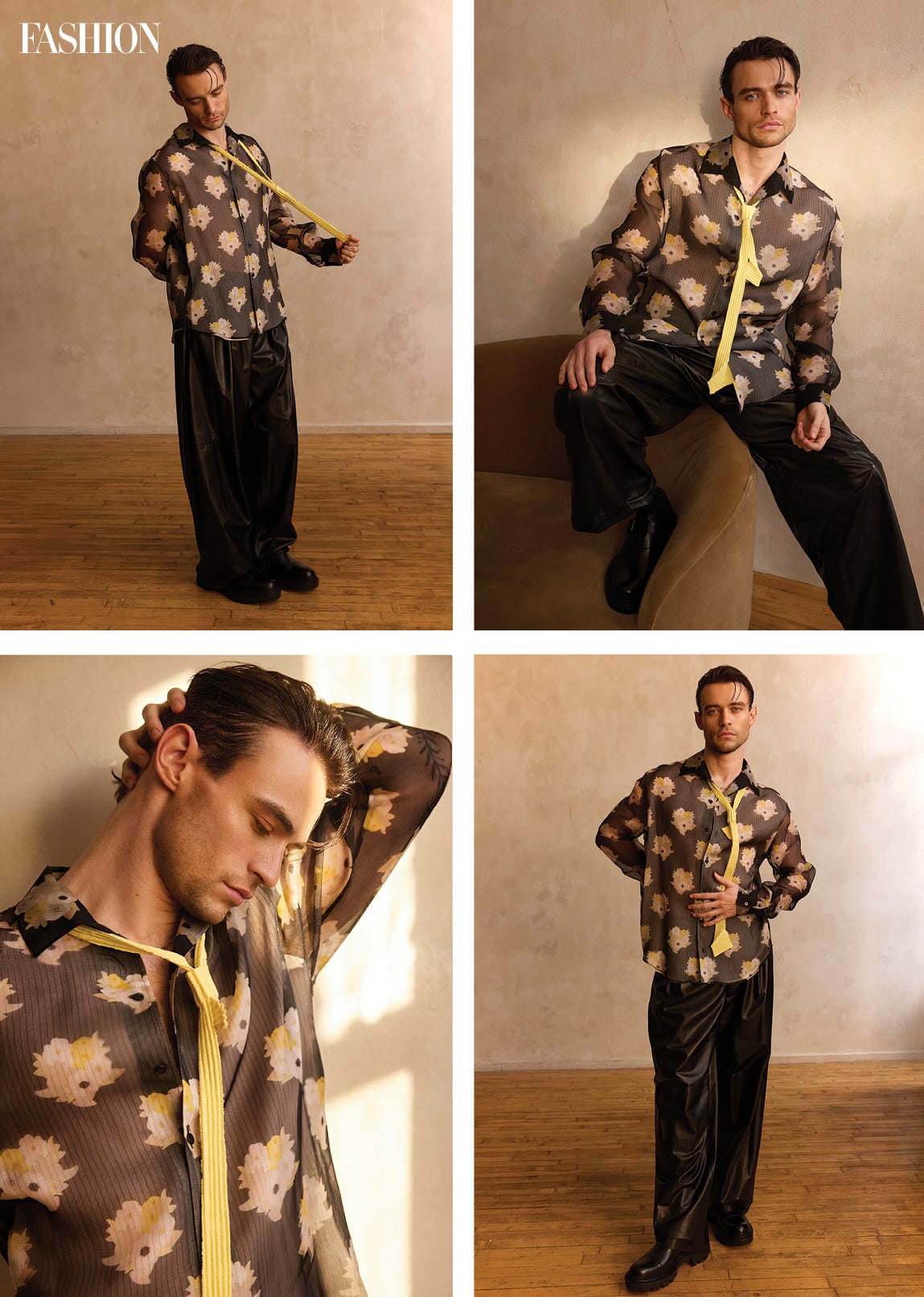
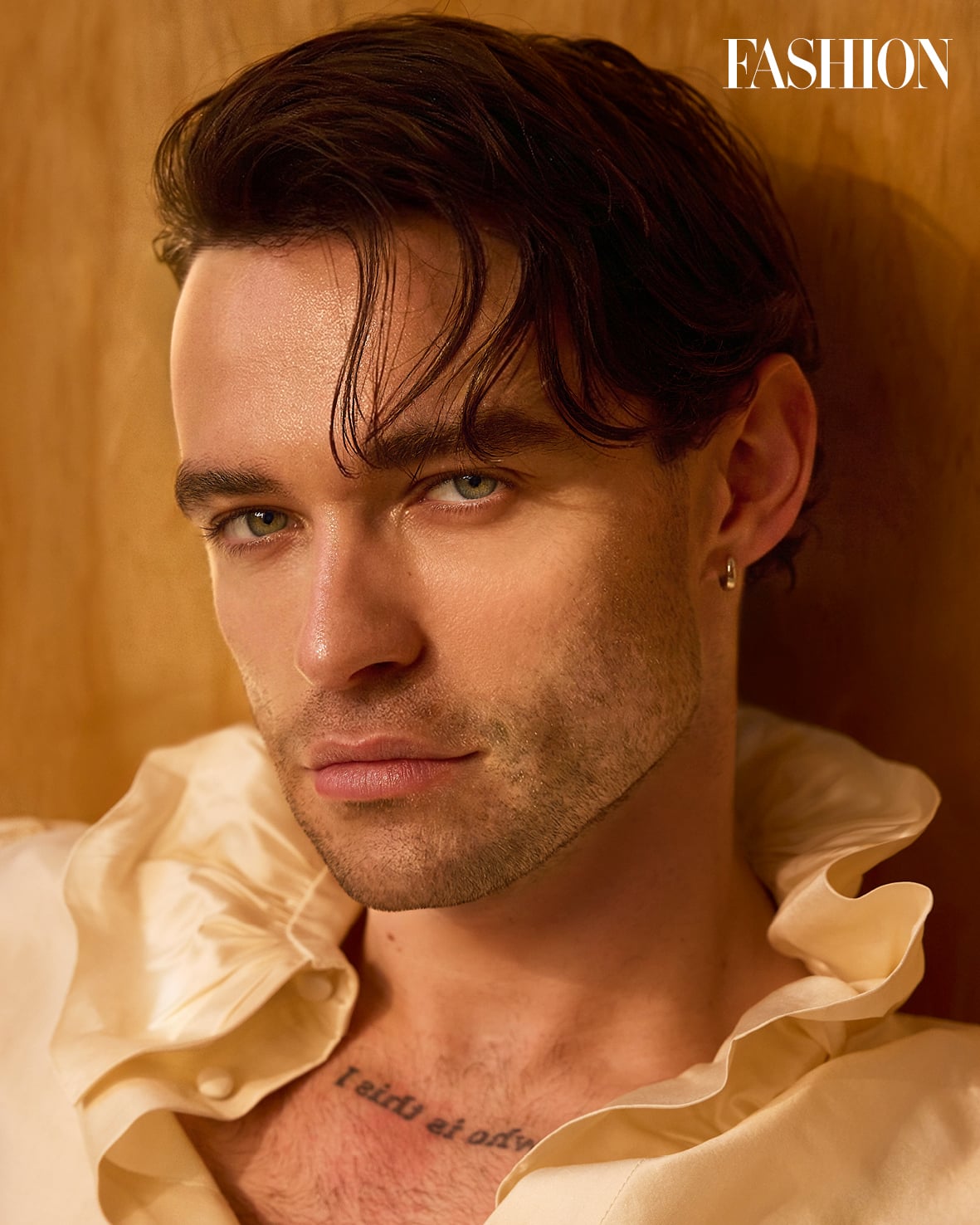
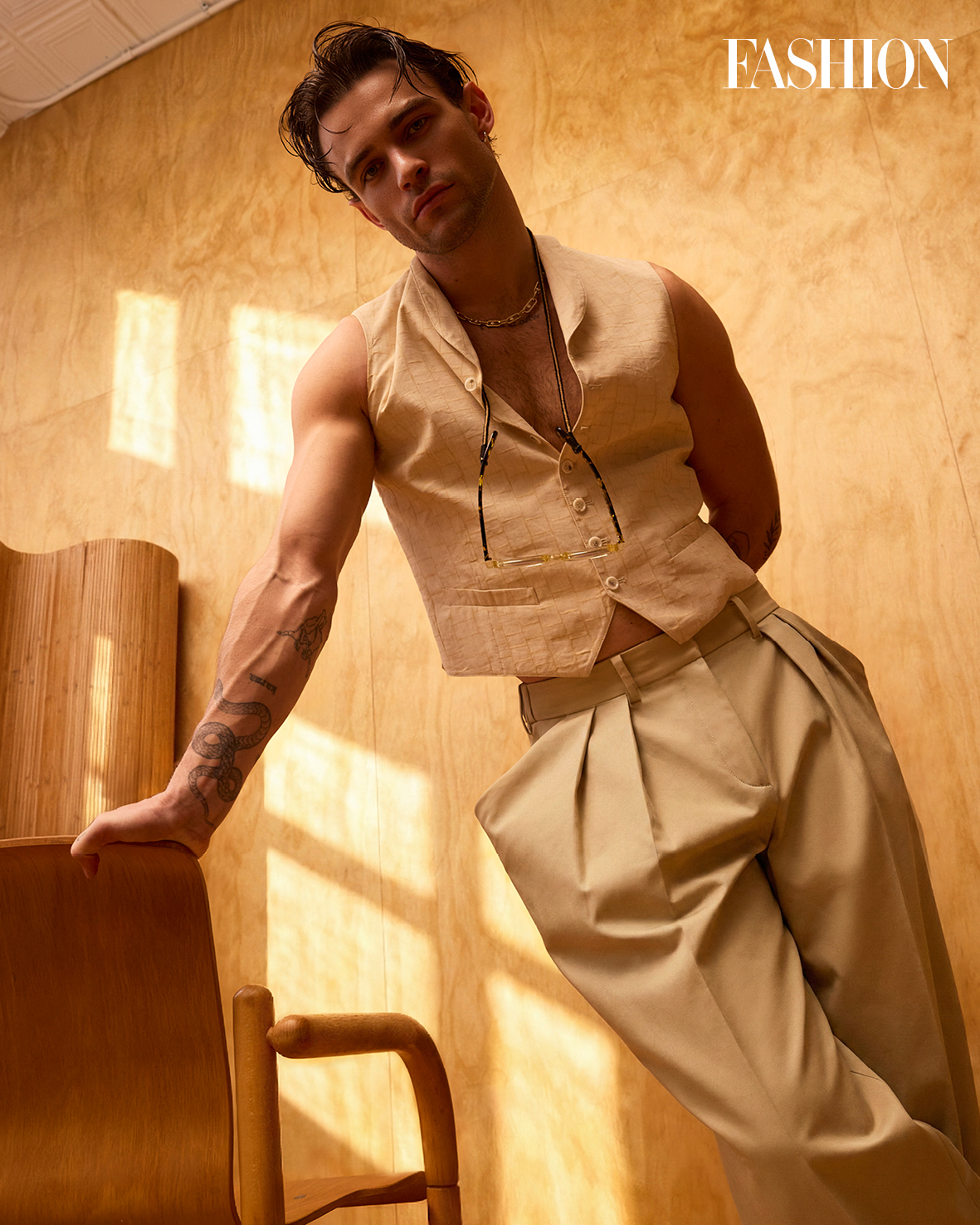
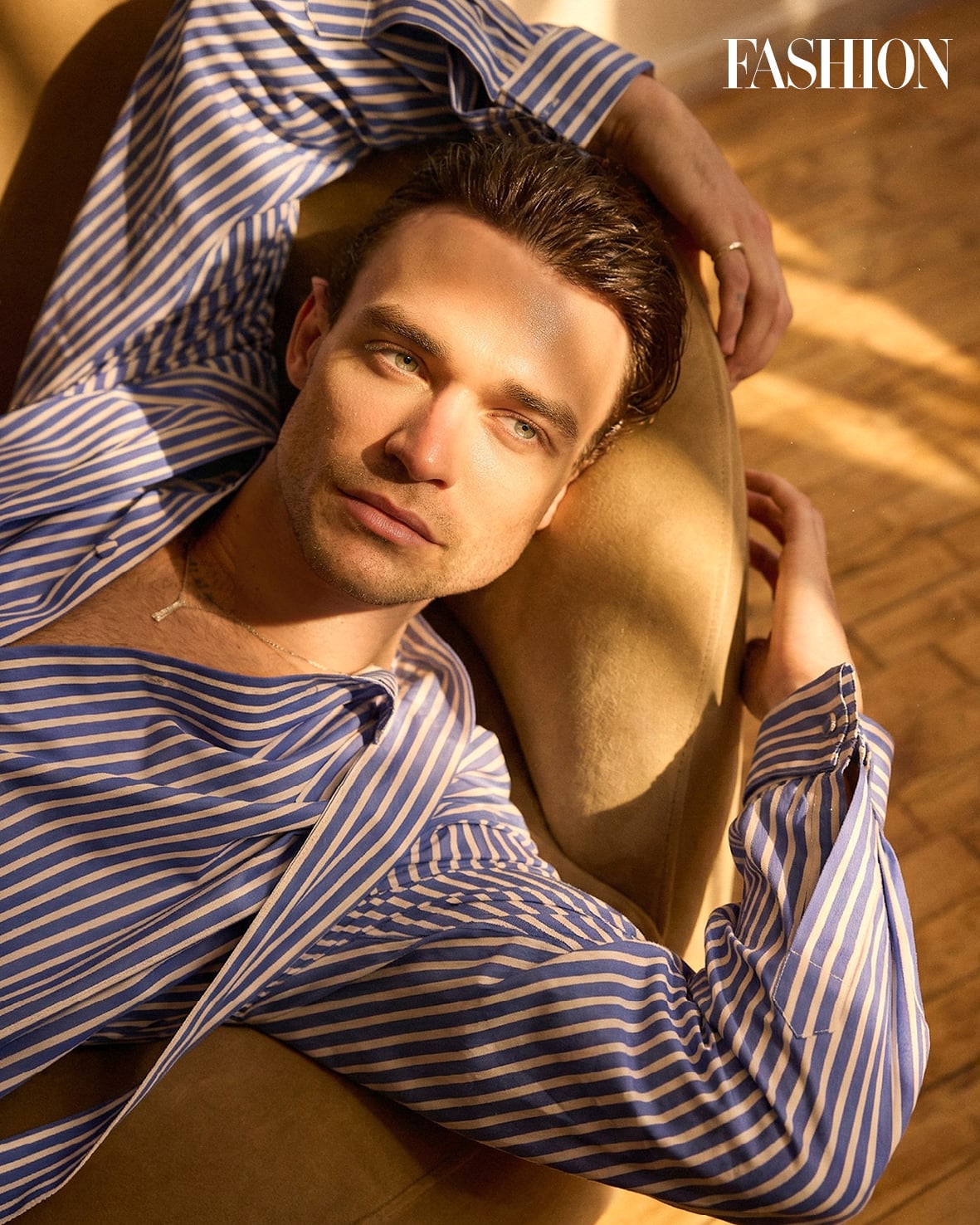

Top, Giorgio Armani. Pants, Aknvas. Necklace, Messika. Glasses, Moscot. Earring, Doherty’s own.
Doherty says that rather than having material desire, he’s fixated on the deep, inexhaustible reserve of selfhood, on peeling back more layers of his own emotional life, on excavating new planes of his interiority so he can hold them under the spotlight for thousands of people to see. That, to him, is honesty.
As our conversation draws to a close, he asks me, “Do you know the musical Next to Normal?” I tell him that I don’t. I’ve only recently been radicalized into the world of musical theatre by a friend who sings show tunes compulsively. “There’s this song in it called ‘Light,’” he says. “I love that song. It’s one of my favourites. There’s this line in it that has always stuck with me, where this character Natalie sings: ‘Give me pain, if that’s what’s real. / It’s the price we pay to feel.’”
All Doherty wants is something real—even if it’s tough, even if it’s uncomfortable, even if it hurts. “I don’t think you can evolve as an actor if you don’t do the work as a human being,” he says. “You have to be able to open yourself up to the world.”

Photography, Nick Merzetti. Publisher, Deidre Marinelli. Creative direction, George Antonopoulos. Editor-in-Chief, Liz Guber. Styling, Ashley Galang. Grooming, Amanda Wilson for A-Frame. Lighting technician, Juan Diego Delgado. Producers, Alexandra Strasburg and Ernest Klimko for AGPNYC. Fashion assistant, Hodaly Garcia. Fashion intern, Sheila Benitez.
Read more stories from FASHION’s March 2026 issue here.