In 1979, work began to convert the Gare D’Orsay railway station in Paris into the Musée D’Orsay, transforming the Beaux-Arts space on the left bank of the Seine from housing trains and travellers to fine works of painting and sculpture. The architect tasked with the project was Gae Aulenti, the visionary Italian creative who also lent her eye to updating such landmarks as the Palazzo Grassi in Venice and a portion of Paris’s Centre Pompidou.
What does Aulenti have to do with Louis Vuitton and watchmaking? Quite a lot, actually. Back in 1988, when the Maison first entered into horology, it partnered with Aulenti to help lead the way. This was just a few years after she completed work on the Musée D’Orsay, which, coincidentally, boasts a massive clock as a key architectural feature.
The result of this creative partnership was Louis Vuitton’s first-ever pair of wristwatches, the LV I and LV II. In keeping with Aulenti’s forward-looking ethos, the watches became revolutionary for their lug-free, pebble-shaped cases. The LV I’s 40-millimetre case came in high-shine white or yellow gold. The LV II, meanwhile, was smaller, at 37 millimetres, and featured an innovative scratch-resistant ceramic case in either black or green. On both, a crown set at the 12 o’clock spot offered a nod to old-school pocket watches. The watch’s face could be called busy (a compliment, to be clear), with a railway track and date displays and GMT and world time functions.
Louis Vuitton Fall 2025. Photography via launchmetrics/spotlight
The watches picked up a new nickname—Monterey (so-called thanks to the American interpretation of montre, French for wristwatch)—and have maintained their status as collector’s items. Original LV IIs even appeared on some models during Louis Vuitton’s Fall 2025 runway show, layered over a blouse sleeve or with the face of the watch worn around the neck as a pendant.
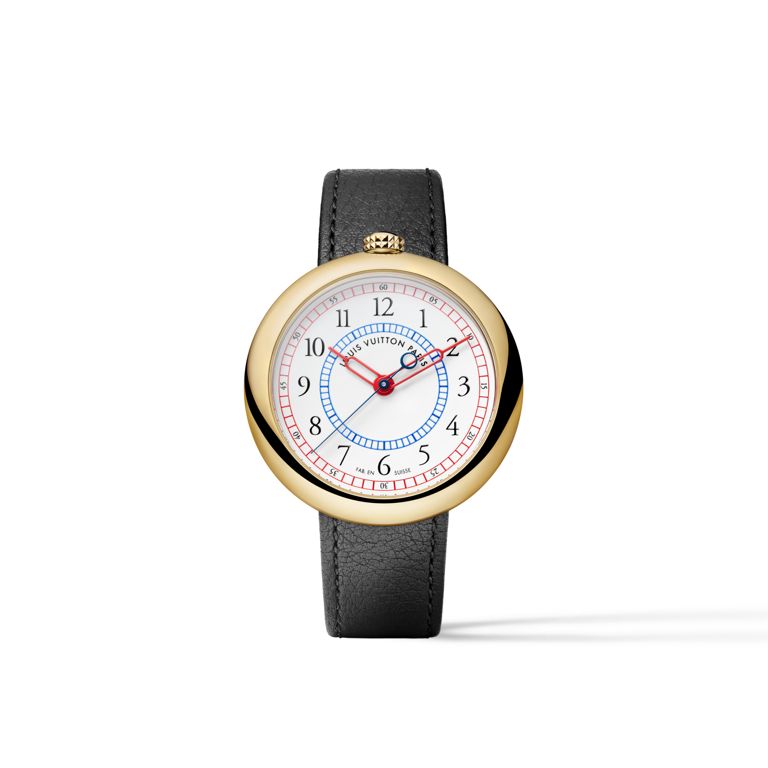
Those runway sightings turned out to be a sign of what’s to come: the reimagined, modern-day Louis Vuitton Monterey. This singular ode is a limited edition, with only 188 produced. It comes in a 39-millimetre yellow-gold case in the familiar pebble shape and boasts a glossy Grand Feu enamel dial—its gleaming warm tone the ideal complement to the watch’s vintage inspiration. And while the graphic elements are stripped back, the red and blue accents of the twin hour and minute scales offer continuity with the original.
The watch maintains the crown at 12 o’clock and is powered by an in-house automatic movement (hidden beneath a closed caseback) instead of the original quartz calibre, while the signature quick-release strap is identical to that of the 1988 versions. Another welcome modern upgrade? A 45-hour power reserve.
Even with the watch’s slew of updates and reinterpretations, the spirit of Aulenti’s avant foray into watchmaking remains. Much like the reimagining of the D’Orsay, it’s not about knocking down the walls but endeavouring to refurbish them.
Louis Vuitton Monterey
This article first appeared in FASHION’s November 2025 issue. Find out more here.
This article contains affiliate links, so we may earn a small commission when you make a purchase through links on our site at no additional cost to you.
Liz Guber is the Editor-in-Chief of FASHION. In her own words, she's "less interested in telling you what to buy, but rather why you want to buy it." Her work has appeared in The Kit, ELLE Canada, The Globe and Mail, the Toronto Star and Girlboss.
Copy link
Advertisement
Advertisement
Subscribe to FASHION!
FASHION magazine inspires and empowers with fashion and style trends, aimed at all sizes, ages, ethnicities, genders, and sexual orientations.